
Panduan Saiz Kerusi Roda for a Better FitCategoriesUncategorized

Panduan Saiz Kerusi Roda for a Better Fit

A wheelchair can have an excellent motor, a lightweight frame, and an attractive modern design, yet still feel difficult to use if the fit is wrong. This panduan saiz kerusi roda helps users, families, and caregivers choose dimensions that support comfort, safer posture, easier transfers, and greater confidence during everyday movement.

Wheelchair sizing is not simply about selecting small, medium, or large. The best size depends on the user’s body measurements, mobility level, daily routine, home layout, vehicle transport needs, and whether the chair will be used mostly indoors, outdoors, or both. A chair that is too narrow can create pressure and discomfort. One that is too wide may make self-propelling, reaching the armrests, and passing through doorways more difficult.

Why wheelchair size affects daily independence

A well-sized wheelchair gives the user stable support without making them feel restricted. It helps keep the pelvis positioned correctly, allows the feet to rest securely, and reduces the effort needed to move, turn, or transfer from the chair to a bed, sofa, toilet, or car seat.

For a caregiver, correct sizing also matters. A wheelchair that is too large may be harder to maneuver through a hallway or lift into a vehicle. A chair that is too small can cause the user to slide forward, lean to one side, or experience discomfort after only a short period of sitting.

This is especially relevant when choosing an electric wheelchair. Battery range, motor power, folding mechanism, and chair weight are all valuable features, but the seating dimensions still need to suit the person using it. Comfort is not an extra feature. It is the foundation of consistent, confident mobility.

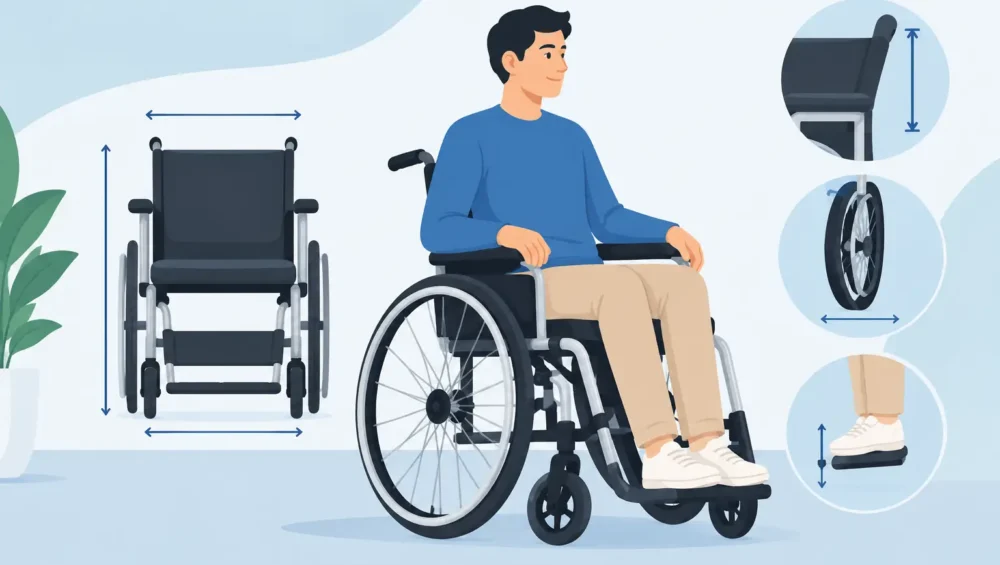
Panduan saiz kerusi roda: the measurements to check

Before comparing models, measure the user while they are seated in their usual posture. Wear the clothing and shoes normally used for outings, particularly if the wheelchair will be used outside. A soft measuring tape is usually the easiest tool.

Seat width

Measure across the widest part of the hips or thighs while seated. Add approximately 1 to 2 inches for comfortable movement and clothing clearance.

For example, if the user measures 17 inches across the hips, a seat width around 18 to 19 inches may be suitable. The user should not feel squeezed at the hips, but there should not be a large gap on either side. Too much extra width can make it harder to maintain a centered posture and may prevent the arms from resting naturally on the armrests.

Users with changing body weight, heavier winter clothing, or medical equipment may need additional room. For larger users, do not look at seat width alone. Confirm the overall chair width and the maximum supported user weight as well.

Seat depth

Seat depth is measured from the back of the buttocks to the back of the knee. Choose a seat that ends about 1 to 2 inches before the back of the knee.

A seat that is too deep can press against the back of the knees and encourage slouching. A seat that is too shallow may not support enough of the thighs, which can make long periods of sitting feel tiring. Proper thigh support helps distribute pressure more evenly, especially for users who spend many hours in their wheelchair.

Reclining and tilt-capable chairs can offer additional positioning options, but they do not replace a correctly sized seat. The starting position should still be stable and comfortable.

Seat height

Seat height is the distance from the floor to the top of the cushion. This measurement affects transfers, foot support, dining-table access, and the ability to move close to a desk or countertop.

For users who self-propel a manual wheelchair with their feet, a lower seat may be more practical. For users transferring to a bed, car, or toilet, the ideal height often depends on the height of those surfaces. A seat that is much lower or higher than the transfer surface can make the movement more challenging.

In an electric wheelchair, seat height also influences how easily the user can reach light switches, tables, and elevator controls. Check the chair specifications with the cushion included, because a thicker pressure-relief cushion can noticeably change the final sitting height.

Backrest height and support

Backrest height should match the user’s trunk strength and support needs. Someone with strong core control may prefer a lower backrest for arm movement and a lighter feel. A user with limited trunk stability may benefit from a taller backrest, head support, lateral supports, or a reclining system.

The right choice depends on the person, not just their diagnosis. A user who can sit upright at home may still need more support for longer outdoor trips or uneven terrain. If the wheelchair is being selected for an elderly parent or someone recovering from illness, comfort over several hours should be assessed, not only during a quick seated test.

Armrest, footrest, and leg position

Armrests should allow the shoulders to stay relaxed rather than raised. The user’s elbows should rest comfortably, with the forearms supported when needed. Removable or flip-up armrests can be useful for side transfers, but they should remain secure during use.

Footrests need to support the feet fully without causing the thighs to lift off the cushion. If the footrests are too high, pressure may build under the thighs. If they are too low, the feet may drag or the legs may feel unsupported. The knees should generally be positioned at a comfortable angle, with adequate clearance from walls, curbs, and uneven surfaces.

Do not forget the wheelchair’s outside dimensions

The seat may fit perfectly, but the wheelchair also needs to fit the user’s environment. Measure the narrowest doorways, bathroom entrance, hallway turns, elevator space, and the area beside the bed. If the chair will travel in a car, measure the trunk opening or cargo area before choosing a folding model.

This is where trade-offs often appear. A wider, heavy-duty wheelchair may provide greater comfort and higher weight capacity, but it can be less convenient in tight indoor spaces. A compact folding chair may be easier to transport, but users should make sure its seat dimensions, suspension, and range meet their daily needs.

For outdoor use, consider more than size. Larger wheels, stronger motors, ground clearance, and stable construction can make a meaningful difference on ramps, parking areas, tiled walkways, and uneven pavement. A chair for shopping centers and smooth indoor floors may not be the best choice for rougher terrain.

Match the chair size to the user’s lifestyle

A lightweight travel wheelchair can be ideal for someone who frequently rides in a car, visits family, or needs a chair that can be folded and lifted more easily. However, a very lightweight chair is not automatically the best option for every user. Someone who needs extra postural support, a reclining backrest, or a higher weight capacity may be better served by a more substantial model.

For bariatric users, look for a chair designed specifically for higher payloads rather than simply choosing the widest available seat. Frame strength, wheel construction, motor performance, battery capability, and turning stability all need to work together. Some heavy-duty models support up to 200 kg, but the appropriate option should still be selected based on body measurements and intended use.

If the chair is for a person with limited hand strength, automatic folding, powered recline, joystick placement, and transfer-friendly armrests may matter as much as the actual seat dimensions. For caregivers, features such as attendant controls, braking, removable cushions, and manageable transport weight can reduce daily strain.

Test the fit before making a final decision

Specifications provide a useful starting point, but a test drive reveals details that a measurement chart cannot. Sit in the chair for more than a few minutes. Check whether the hips remain centered, the back is supported, the feet rest naturally, and the user can reach the joystick or wheels without stretching.

Try turning through a tight space, approaching a table, moving over a small threshold, and transferring in and out if possible. Ask whether the chair will still feel practical after an hour, not only whether it feels comfortable at first.

At Vechair, users can test drive different wheelchair configurations with guidance from trained staff. This is particularly helpful when comparing compact folding chairs, lightweight carbon or magnesium options, recline models, and heavy-duty designs. A professional fitting conversation can also account for cushions, posture needs, home access, and future changes in mobility.

A wheelchair should help a person take part in daily life with less hesitation, whether that means moving around the home, joining a family outing, or traveling independently. Bring the user’s measurements, think honestly about where the chair will go each day, and allow enough time to test the fit. The right size is the one that supports both the body and the life the user wants to keep living.

CategoriesUncategorized

Kerusi Roda Elektrik untuk Kapal Terbang

A flight should not mean leaving independence behind. If you are searching for a kerusi roda elektrik untuk kapal terbang, the right choice is not simply the lightest chair available. It is a power wheelchair that suits your body, daily life, battery requirements, and the way an airline will handle it from check-in to arrival.

For many travelers, the greatest concern is not the time in the air. It is whether the wheelchair will arrive safely, whether the battery will be accepted, and whether they can move comfortably through a large airport. With thoughtful preparation and a travel-ready chair, flying can feel far more manageable for the user and the family member traveling alongside them.

What Makes an Electric Wheelchair Air-Travel Ready?

There is no single universal label that guarantees a power wheelchair can fly on every airline. Airlines follow safety rules for mobility devices, especially batteries, but their procedures and approval requirements can differ. A chair that is acceptable on one route may require additional confirmation on another.

The battery is usually the first issue. Lithium-ion batteries, sealed lead-acid batteries, and gel batteries are handled differently. Many folding electric wheelchairs use removable lithium batteries, which can be practical because the battery may need to travel in the cabin rather than remain attached to the chair in the cargo hold. However, the airline must confirm the battery rating, protection method, and quantity allowed.

This is why battery documentation matters. Keep the battery specification available, including its watt-hour rating, chemistry, voltage, and capacity. A clear manufacturer label is helpful, but a printed specification sheet can prevent confusion at check-in. If the battery can be removed, practice doing it before travel and make sure the terminals can be protected from accidental contact.

Chair dimensions and weight matter too. A compact folding model is easier for airline ground crews to move and often easier for families to transport by car before and after a flight. But compact does not automatically mean suitable. The chair must still provide stable seating, sufficient range, appropriate user weight capacity, and reliable performance for the destination.

Choosing a Kerusi Roda Elektrik untuk Kapal Terbang

Start with how the chair will be used after landing. A very light chair may be excellent for airport transfers, hotels, shopping areas, and smooth sidewalks. But if the trip includes uneven paths, steep slopes, or long outdoor distances, a small travel chair may not be the right compromise.

For frequent flyers, a folding electric wheelchair made from carbon fiber or magnesium can be an appealing option. These materials can reduce overall chair weight while maintaining a modern, durable structure. Lightweight models are also easier for caregivers to lift into a vehicle, although no one should rely on lifting a chair beyond what they can handle safely.

Automatic folding is useful for travelers who want less physical effort during transfers. It can make packing more convenient, but users should still understand the manual release and folding process. If an airport agent needs to prepare the chair quickly, simple instructions attached to the wheelchair can make a meaningful difference.

A reclining chair may offer greater comfort for users who need pressure relief, postural support, or a position change during a long day of travel. The trade-off is that reclining mechanisms may add weight and complexity. Similarly, an XL or bariatric model can provide the support and strength needed for a larger user, but its size and weight should be discussed with the airline well before departure.

The best choice depends on the traveler, not a marketing label. A chair needs to fit the user correctly, support their weight, turn safely in tight spaces, and meet the real demands of airport and destination travel.

Call the Airline Before You Book

Do not wait until the day before a flight to mention a power wheelchair. Contact the airline before booking if possible, then reconfirm the request after the ticket is issued. Tell them the device is an electric wheelchair and provide the chair’s dimensions, total weight, battery type, battery watt-hour rating, and whether the battery is removable.

Ask how the airline wants the wheelchair prepared for loading. Some carriers require the device to be powered off and placed in drive mode; others may request that it be placed in freewheel mode only after it reaches the aircraft. Never assume that an unfamiliar staff member knows your chair’s controls.

It also helps to ask whether the airline has cargo-door size restrictions. This is especially relevant for larger power wheelchairs and smaller regional aircraft. If your journey includes connecting flights operated by different carriers, confirm the arrangements with every operating airline, not only the airline that sold the ticket.

Request mobility assistance for the airport as well. Most power wheelchair users remain in their own chair until the aircraft door, then transfer to an aisle chair and their assigned seat. The power wheelchair is usually checked at the gate and returned at the aircraft door or another designated point after landing. Confirm the process in advance so there are no surprises at the gate.

Prepare the Chair for Airport Handling

Airports are busy environments, and even careful ground handling can expose a wheelchair to knocks, pressure, and rushed decisions. Preparing the chair clearly is one of the most practical ways to protect it.

Attach a durable instruction card in plain English. State how to turn the chair on and off, where to find the freewheel levers, how to engage and disengage them, where the battery is located, and safe lifting points. Include a contact number for the traveler or caregiver. Avoid instructions that are too technical for someone who sees the model for the first time.

Remove loose accessories when possible. A detachable joystick, cup holder, phone mount, cushion, side bag, or oxygen holder can be damaged or misplaced during handling. Store essential removable items with you in the cabin if permitted. Take photos of the wheelchair from several angles before check-in, including the control panel, tires, armrests, and frame.

Before arriving at the airport, check these essentials:

  • Battery label and printed battery specifications
  • Airline approval or notes from your prior call
  • A simple handling and freewheel instruction card
  • Protective covers for terminals or removable components
  • Photos showing the chair’s condition before handover

Charge the battery according to the manufacturer’s guidance before travel. Do not attempt improvised battery modifications to meet an airline request. If there is uncertainty, speak with the airline and your wheelchair supplier before the trip.

At the Airport: Give Yourself More Time

Arrive earlier than a traveler without mobility equipment. You may need extra time for check-in, battery inspection, security screening, gate coordination, and transfer arrangements. Rushing is where communication breaks down.

At check-in, calmly repeat the chair’s handling requirements and show the instruction card. At the gate, ask to speak with the staff coordinating the wheelchair loading. Explain whether the chair has a removable battery and make sure the chair is handed over only when you are ready to transfer.

If you use a seat cushion for posture or pressure management, discuss whether it can travel with you. If it is essential for your comfort, do not allow it to disappear with checked baggage unless there is no alternative. Keep medication, chargers approved for cabin use, transfer aids, and other necessary personal items in your carry-on.

Check the Chair Immediately After Landing

When your wheelchair is returned, inspect it before leaving the airport area. Check that it powers on, moves forward and backward, steers correctly, and has no visible damage to the frame, joystick, battery compartment, wheels, or footrests. Confirm that any removed component has been returned.

If there is damage, report it immediately to the airline’s baggage or accessibility desk. Use the photos taken before departure and ask for a written report. Even minor damage to a joystick mount, cable, or battery connection can affect safe use later.

A dependable chair also needs dependable support after the trip. This is where a specialist provider makes a practical difference. Vechair supports users through sales, service, and spare parts, with trained guidance for test drives and models designed around real mobility needs – from compact travel chairs to heavier-duty options.

Flying with a power wheelchair takes planning, but it should not take away the freedom to visit family, attend important events, or see a new place. Choose a chair that fits your life, prepare it with care, and give the airline clear information. Confidence often starts long before takeoff.

Uji Pandu Kerusi Roda Kuala Lumpur: What to TestCategoriesUncategorized

Uji Pandu Kerusi Roda Kuala Lumpur: What to Test

A wheelchair can look excellent in a product photo and still feel wrong within five minutes of use. The seat may be too deep, the joystick may sit at an awkward angle, or the chair may struggle at the doorway and ramp that matter most. That is why an uji pandu kerusi roda Kuala Lumpur appointment is not simply a demonstration. It is a practical way to check whether a mobility solution supports real daily life.

For a first-time user, a test drive can replace uncertainty with clear answers. For an experienced wheelchair user, it is the opportunity to compare materials, folding systems, motor response, suspension, and seating comfort before making a change. The best choice is not necessarily the lightest, fastest, or most automated chair. It is the chair that fits the user, the home, the vehicle, and the routes they travel every week.

Why a Wheelchair Test Drive Matters

Mobility needs are personal. A compact folding electric wheelchair may be ideal for a user who travels by car and needs family members to lift it into the trunk. A reclining model may be more appropriate for someone who spends longer periods seated or needs pressure relief. A larger user may need a bariatric chair with a verified capacity of up to 200 kg, a wider seat, and stronger frame support.

Specifications help narrow the options, but they cannot tell you how a chair feels when turning beside a dining table, moving over a slightly uneven surface, or stopping on an incline. During a professional test drive, the user can experience those details safely while trained staff observe posture, control access, and handling.

This is especially valuable when a family member is purchasing for a parent, spouse, or dependent. Caregivers often focus on safety and transport, while the user focuses on comfort, confidence, and independence. Both perspectives matter. A good test drive gives everyone a chance to discuss the trade-offs before a purchase is made.

What to Check During an Uji Pandu Kerusi Roda Kuala Lumpur Visit

A showroom test should feel like a real assessment, not a rushed lap around the floor. Start by explaining how the wheelchair will be used: indoors, outdoors, at work, in a condominium, during travel, or for longer neighborhood journeys. Bring details that can affect the recommendation, such as the width of narrow doorways, the height of a vehicle trunk, body weight, and whether the user needs help transferring in and out of the chair.

Comfort begins with fit

Sit in the chair long enough to notice the details. Check whether the seat width supports the hips without feeling restrictive, whether the seat depth supports the thighs without pressing behind the knees, and whether the footrests can be adjusted to a comfortable height. Armrest height also affects shoulder comfort, particularly for users who transfer from the chair or spend several hours seated.

Ask about cushions, back support, headrests, and reclining functions where relevant. A soft seat is not always the most supportive seat. The right setup depends on the user’s posture, duration of use, skin-care needs, and ability to reposition independently.

Controls should feel natural, not intimidating

For an electric wheelchair, test the joystick at low speed first. The user should be able to start, stop, turn, and reverse without overreaching or tensing the shoulder. Pay attention to how the chair responds when the joystick is released. Smooth braking and controlled acceleration can make a major difference for a new user or someone with reduced hand strength.

If the user has limited dexterity, ask whether the controller position can be adjusted or whether alternative control arrangements are available. Technology should reduce effort, not create another obstacle. Features such as automatic folding, recline, and attendant controls can be genuinely helpful, but only when they match the user’s routine.

Test turning, slopes, and surface changes

A wheelchair needs to work beyond a flat showroom aisle. Practice tight turns, reverse movement, stopping near an obstacle, and crossing a small threshold under staff guidance. If the chair is intended for outdoor use, ask about wheel type, suspension, ground clearance, and the terrain it is designed to handle.

A lightweight carbon or magnesium model can make transport easier, but an ultra-light frame may not be the best match for frequent rough terrain. An off-road or heavy-duty chair may offer better stability and traction, yet its larger size and weight can make car transport more demanding. There is no universal winner. The correct decision depends on where the chair will go most often.

Do not forget transport and storage

Many purchases become frustrating because the chair fits the user but not the car. If possible, measure the trunk opening, storage space, elevator dimensions, and tightest doorway at home before visiting the showroom. Ask to see the folding process yourself. Then ask a caregiver to try it too.

A chair described as foldable may still require lifting, removing batteries, or managing a heavier frame than expected. Compact designs are useful for urban living and car travel, while automatic-folding models can reduce handling effort. However, the best option still needs to be practical for the person who will load, unfold, charge, and maintain it.

Questions Worth Asking Before You Decide

A mobility device is a long-term purchase, so the conversation should continue beyond the test drive. Ask what warranty coverage applies to the motor, battery, charger, and controller. Also ask where repairs are handled, whether replacement parts are available locally, and how routine service is arranged.

At Vechair, the 3S approach – sales, service, and spare parts – reflects an important reality of electric mobility: ongoing support matters as much as the first day of ownership. A chair may be technically advanced, but it should also be backed by qualified service and accessible replacement components when needed.

It is also sensible to ask about charging time, expected range, battery care, and the chair’s maximum safe load. Do not treat load capacity as a rough estimate. The total can include the user’s body weight, cushion, bags, oxygen equipment, or other items carried on the chair. Staying within the stated capacity protects performance, stability, and component life.

For added reassurance, confirm that the product is registered or certified for its intended medical-device use in Malaysia. Clear warranty terms and documented product support are not extras. They help protect mobility, independence, and peace of mind after the purchase.

How Families Can Make the Test Drive More Useful

If the chair is for a loved one, attend together whenever possible. The user should be the one operating and sitting in the chair, while family members evaluate lifting, folding, storage, charging, and transfer support. Avoid deciding based only on appearance or a single feature such as low weight.

Take your time. Compare two or three suitable configurations rather than trying every model in the showroom. A compact 11 kg chair, a reclining chair, and a heavier-duty outdoor chair serve very different needs. Comparing the right categories makes the decision clearer and less exhausting.

It helps to write down a short list of daily situations before the appointment: getting from bedroom to bathroom, entering an elevator, visiting a clinic, going to the mall, loading into the car, or moving outside after rain. These examples give the consultant a practical picture of what success looks like for the user.

Confidence Is the Most Important Test Result

A successful test drive is not measured by how many features a wheelchair has. It is measured by whether the user feels secure enough to move forward, turn comfortably, and imagine using the chair in ordinary life. The right chair should support dignity as well as mobility – modern, capable technology that helps a person remain connected to home, family, and the places they enjoy.

Before leaving the showroom, make sure the user has had enough time in the chair to form a real opinion. The best mobility decision is often the one that feels calm, practical, and reassuring from the first controlled ride.

Alat Ganti Kerusi Roda Elektrik: What to CheckCategoriesUncategorized

Alat Ganti Kerusi Roda Elektrik: What to Check

A wheelchair that stops halfway through a grocery trip, pulls to one side on a ramp, or loses charge faster each week is not simply inconvenient. It can take away the confidence to leave home independently. The Malay search term alat ganti kerusi roda elektrik refers to electric wheelchair spare parts, and choosing the right replacement part is about restoring safe, reliable everyday movement – not just getting the chair running again.

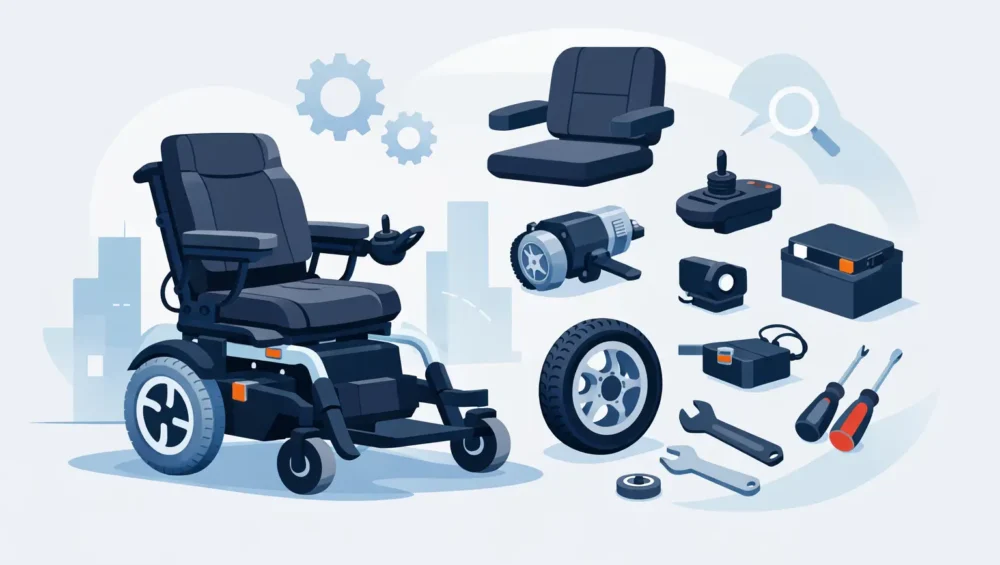
Electric wheelchairs are made of systems that work together: battery power, motors, controller, wheels, brakes, seating, and folding mechanisms. A small fault in one component can affect how the entire chair performs. For users, caregivers, and families, understanding the most common replacement parts makes repair decisions clearer and helps prevent an avoidable breakdown.

Start With the Symptom, Not the Part

It is tempting to order a battery when the chair has less range or replace a motor when the chair feels weak. But the visible symptom does not always identify the failed component. A loose battery connection, damaged charger port, worn tire, or controller setting can create a problem that feels much larger than it is.

Start by noting exactly when the issue occurs. Does the chair fail to power on? Does it charge but stop quickly? Does one wheel make noise only when turning? Does the joystick respond slowly, or does the chair display an error code? These details give a service technician a far better starting point than a general description such as “the wheelchair is not working.”

For a chair still under warranty, do not replace electrical components before confirming the warranty terms. Motors commonly have different coverage from batteries, chargers, and controllers. Using an incompatible part or altering wiring without professional guidance can create a safety risk and may affect coverage.

The Electric Wheelchair Parts That Matter Most

Batteries and Chargers

Battery condition has the biggest impact on daily range. Over time, every rechargeable battery loses capacity. If a chair that once handled a full day of local errands now struggles after a short outing, battery age is one possible cause. Cold storage, long periods without charging, repeated deep discharge, and an unsuitable charger can all shorten battery life.

However, batteries are not one-size-fits-all. Voltage, capacity, connector type, physical dimensions, and battery chemistry must match the wheelchair’s requirements. A higher-capacity battery may sound appealing, but it must fit the battery compartment and work correctly with the chair’s electrical system.

The charger deserves equal attention. A charger with damaged cables, a loose plug, overheating, or inconsistent indicator lights should be inspected rather than used repeatedly. Charging with the correct rated charger protects battery health and helps maintain predictable range. For people who depend on their chair every day, a compatible backup charger can also offer useful peace of mind.

Motors, Gearboxes, and Electromagnetic Brakes

Most power wheelchairs use one motor per drive wheel, usually paired with a gearbox and electromagnetic brake. Warning signs of trouble include grinding noises, a new vibration, reduced climbing ability, uneven movement, or one side of the chair responding differently from the other.

A motor problem is not always a motor replacement. Worn tires can reduce traction, debris can interfere with movement, and a wiring or controller issue can limit power delivery. Yet if a motor or gearbox is genuinely worn, installing a matched replacement is essential. Motor specifications, mounting points, connectors, and brake configuration vary by model.

The electromagnetic brake is particularly important because it holds the chair securely when the joystick is released. If the chair rolls unexpectedly, fails to hold on an incline, or cannot be pushed correctly in freewheel mode, stop using it until the brake system has been checked. This is a safety issue, especially for users transferring from the chair or navigating ramps.

Joysticks, Controllers, and Wiring

The joystick is the user’s direct connection to the chair. Sticky controls, delayed response, drifting direction, cracked housing, or unexplained error lights can make even a physically sound chair unsafe to operate. A controller manages power delivery and communicates with the motors, battery, and joystick, so faults in this area can look unpredictable.

Electrical repairs require care. Moisture, impact damage, corrosion, and pulled cables can affect connectors and wiring. Replacing a joystick or controller with an unapproved unit can lead to compatibility problems, incorrect speed behavior, or persistent fault codes. The safest approach is to match the component by chair model, serial information, and original electrical specifications.

Tires, Wheels, and Casters

Tires are often overlooked because they seem simple, but they influence braking distance, ride comfort, turning, and battery consumption. Worn tread can make outdoor surfaces less secure, while low pneumatic tire pressure can make the chair feel heavy and reduce range. Solid tires avoid punctures but may provide a firmer ride. Pneumatic tires offer more cushioning but need routine pressure checks.

Front casters also deserve attention. If they wobble, squeak, resist turning, or show uneven wear, the chair may pull or feel unstable. A caster replacement should match the original diameter, width, axle size, and load requirement. This matters even more for heavy-duty and bariatric wheelchairs, where every component must support the intended user weight.

Seating, Armrests, Footplates, and Support Parts

Not every replacement part is electrical, but comfort and posture directly affect how long someone can use an electric wheelchair safely. Torn cushions, loose armrests, cracked footplates, damaged calf straps, and worn seat belts can make daily use painful or risky.

A replacement cushion should support the user’s pressure-relief and positioning needs, not just fit the seat dimensions. Footplates must stay secure and provide proper leg support. For reclining or power-adjustable models, actuators, switches, and mounting hardware should be assessed by a qualified technician because seating movement affects balance and transfer safety.

How to Choose Compatible Alat Ganti Kerusi Roda Elektrik

The right spare part begins with accurate information. Keep a record of the wheelchair brand, model, serial number, purchase date, and any part labels. Clear photos of connectors, mounting brackets, tire markings, and error displays can prevent an incorrect order.

Price matters, but the cheapest replacement is not always the best value. An unverified battery may have lower real capacity than stated. A poorly matched controller can cause performance problems. A low-quality tire may wear quickly or compromise traction. For a device that carries a person over thresholds, sidewalks, ramps, and uneven ground, fit and reliability matter more than a small upfront saving.

There are also practical trade-offs. A lightweight folding chair may use compact components designed for portability, while an off-road or 200 kg capacity chair needs more substantial motors, wheels, and suspension-related parts. The part that suits one chair cannot automatically be fitted to another, even if it looks similar.

When Repair Makes Sense – and When It Does Not

Replacing a charger, tire, joystick, battery, or seat component can extend a wheelchair’s useful life significantly. Repair is usually sensible when the frame, seating structure, and primary drive system remain in good condition and replacement parts are available.

A broader assessment may be wiser when faults keep returning, water damage has affected multiple electrical systems, repairs approach the cost of a newer chair, or the user’s needs have changed. A chair that was ideal for short indoor trips may no longer be suitable for outdoor terrain, longer distances, vehicle transport, or increased support needs.

At Vechair, this is why service and spare-parts support matter alongside the initial purchase. A professional inspection can identify whether one component needs replacement or whether several systems are nearing the end of their service life. It also gives users and caregivers a realistic answer before spending money on parts that may not solve the actual problem.

Simple Habits That Help Parts Last Longer

Regular care reduces unexpected repairs. Charge the battery as recommended for the specific model, keep electrical connections dry, and avoid storing the chair for long periods with a fully depleted battery. Check tire condition, wheel fasteners, and joystick function before longer outings.

After rain, wet sidewalks, or dusty outdoor use, wipe down the chair and inspect exposed areas. Electric wheelchairs are designed for real life, but they are not all equally weather-resistant. Avoid pressure washing electrical areas, and never ignore a new warning light, burning smell, repeated clicking sound, or change in braking behavior.

A well-maintained electric wheelchair is more than a machine that moves from point A to point B. It is the confidence to visit family, attend appointments, move through work or home, and choose where the day goes. When a part begins to fail, getting the right diagnosis and compatible replacement can help keep that independence moving forward.

Servis Kerusi Roda Elektrik Rosak ExplainedCategoriesUncategorized

Servis Kerusi Roda Elektrik Rosak Explained

A powered wheelchair that stops halfway to the kitchen, flashes an unfamiliar error code, or loses power on a ramp is more than an inconvenience. It can interrupt work, appointments, family time, and a person’s confidence to move independently. When you need servis kerusi roda elektrik rosak, the right response is not to guess at the problem or force the chair to keep moving. Start with safety, then identify whether the issue is a simple operating check or a fault that needs trained service.

Electric wheelchairs combine batteries, motors, controllers, wiring, brakes, tires, and seating components in one mobility system. A problem in one area can look like a problem somewhere else. For example, a chair that will not move may have a loose battery connection, a disengaged freewheel lever, a depleted battery, or a controller fault. Accurate diagnosis protects both the user and the equipment.

First, Make the Chair and User Safe

If the wheelchair stops unexpectedly, move away from traffic, slopes, stairs, water, and uneven ground if it is safe to do so. Switch off the power before checking any connection. If the user is seated, make sure the chair is stable and the brakes are engaged before attempting a transfer. Do not ask someone to push a powered wheelchair while it is switched on or while its drive system is engaged.

A chair that pulls sharply to one side, makes a grinding sound, smells of overheating, or has damaged cables should not be driven again until inspected. These symptoms can involve the motor, electromagnetic brake, tire, gearbox, or electrical system. Continuing to use it may turn a repairable part into a larger and more costly repair.

Water exposure deserves particular care. Light rain may not immediately stop every model, but wet connectors, a soaked controller, or water entering the battery compartment can create delayed electrical faults. Turn the unit off, dry the exterior, and arrange a professional inspection rather than charging it immediately.

Common Problems Before Electric Wheelchair Repair

Some checks are reasonable for an owner or caregiver, as long as they do not involve opening sealed batteries, controller housings, or motor assemblies. The goal is to rule out the straightforward causes without compromising safety or warranty coverage.

The Chair Will Not Turn On

Begin with the charger and battery status. Confirm the charger is connected to a working wall outlet and that its indicator lights show normal charging behavior. Check that the wheelchair’s battery connector is fully seated and that the key, power button, or joystick power switch is in the correct position.

Many electric wheelchairs also have a circuit breaker or reset button. If it has tripped, reset it once according to the chair’s instructions. If it trips again, stop there. Repeated tripping can signal an overload, short circuit, damaged wiring, or a motor-related issue.

The Chair Turns On but Will Not Move

Check the freewheel mode first. Electric wheelchairs use freewheel levers to disengage the motors for manual pushing during transport or emergencies. If either lever is in freewheel mode, the chair may power on but will not drive normally. Return both levers to drive mode while the chair is off, then restart it.

Also look at the joystick display for flashing lights or an error code. A blinking pattern is useful information for the service technician. Take a photo or short video of the display, noting whether the problem occurs only after charging, on hills, or after the chair has been used for a certain amount of time.

The Range Has Become Much Shorter

A reduced driving range often points to battery age, charging habits, user weight, tire condition, terrain, or temperature. Hills, thick carpet, grass, and frequent stop-start use draw more power than smooth indoor flooring. A heavier load also requires more energy, even when it remains within the chair’s stated weight capacity.

However, a sudden and severe range drop should be checked. Batteries naturally lose capacity over time, but a weak battery, failing charger, corroded connector, or controller issue can produce similar symptoms. Do not replace batteries based on guesswork alone. The battery type, voltage, connector, physical size, and charging profile must match the wheelchair’s requirements.

The Chair Feels Rough, Noisy, or Unstable

Inspect the visible basics: tires should be intact, properly inflated where applicable, and free from deep cuts or embedded debris. Check for loose cushions, armrests, footrests, and anti-tip wheels. Dirt, hair, and string wrapped around wheels can also affect movement.

Grinding, clicking, vibration, or a new delay when starting and stopping is not normal wear to ignore. These signs may relate to wheel bearings, motors, gearboxes, brakes, or suspension parts. A professional evaluation is especially important for outdoor, off-road, reclining, bariatric, and high-capacity wheelchairs because their components work under different loads and stresses.

When Professional Servis Kerusi Roda Elektrik Rosak Is Needed

Professional service is the safer choice whenever the fault involves power delivery, braking, drive motors, joystick controls, wiring, chargers, or error codes that return after a reset. These are not areas for improvised repairs. Incorrect wiring or an incompatible battery can damage the controller, reduce braking performance, or create a fire risk.

Bring useful details to the service team: the wheelchair model, serial number, approximate purchase date, battery age, the issue you noticed, and any display code. Photos and videos help technicians understand intermittent faults that may not appear immediately in the workshop. Explain the user’s usual environment too. A chair used mainly indoors faces different conditions from one regularly used on sidewalks, ramps, gravel paths, or wet weather.

At Vechair Technology, service support is built around the same practical needs that matter when selecting a chair: reliable movement, appropriate parts, and clear guidance. A specialized service provider can assess whether repair, battery replacement, tire replacement, controller work, or a broader safety inspection makes the most sense for the chair’s condition and expected use.

Warranty status should be checked before authorizing repairs. Coverage varies by component and purchase terms. For example, motor coverage may differ from batteries, chargers, and controllers because these parts have different operating lifespans and exposure to wear. Keep your proof of purchase and service records. They can help confirm coverage and give technicians a clearer maintenance history.

Avoid These Costly Repair Mistakes

The fastest-looking fix is not always the safest or least expensive one. Avoid using a car battery, a generic charger with an unmatched voltage, taped electrical connections, or secondhand electronic components of unknown condition. An electric wheelchair is a medical-mobility device, not a standard household appliance.

It is also tempting to keep using the chair when it still moves “a little.” That decision depends on the symptom. A slightly worn tire may be manageable until a scheduled appointment, but unpredictable braking, power cutouts, overheating, or a chair that veers off course require immediate attention. If the chair is essential for daily mobility, arrange backup transport or another mobility option while it is being assessed.

Caregivers should resist lifting or towing a heavy powered chair without proper equipment. Battery-powered wheelchairs can be substantial, particularly reclining, off-road, and XL models designed for higher weight capacities. Incorrect transport can damage the frame, joystick, footrests, or vehicle, and it can injure the people trying to help.

Simple Habits That Reduce Future Breakdowns

Regular care helps a wheelchair deliver more dependable mobility. Charge the battery using the supplied or approved charger, keep the chair dry and clean, and inspect tires and visible cables routinely. Store the wheelchair in a cool, dry location rather than leaving it exposed to direct sun, heavy rain, or long periods of extreme heat.

Pay attention to changes early. A charger light behaving differently, a new beep, slower acceleration, or reduced climbing ability is worth reporting before the chair fails completely. Scheduled checks are particularly valuable before long trips, after a fall or impact, and when a chair has been stored unused for an extended period.

The best repair outcome is not simply getting the wheelchair moving again. It is knowing that the user can leave home, cross a room, visit loved ones, or complete an everyday errand with confidence. Treat unusual behavior as an early signal, and let qualified service restore the safe, dependable movement that independence deserves.

Alat Angkat Pesakit dari Katil: Safer TransfersCategoriesUncategorized

Alat Angkat Pesakit dari Katil: Safer Transfers

Moving someone from a bed to a wheelchair should not require a caregiver to strain their back, pull under the arms, or hope the transfer goes smoothly. An alat angkat pesakit dari katil, commonly called a patient lift or hoist, gives the person being cared for more support and gives the caregiver a safer, more controlled way to manage daily movement.

For many families, the need becomes clear after a fall, surgery, stroke, or a gradual loss of strength. The right lift can make it possible to move from bed to wheelchair, commode, recliner, or bathing area with greater dignity. But choosing one is not simply a matter of buying the highest weight capacity. The person’s mobility, transfer routine, body shape, room layout, and caregiver confidence all matter.

What a Patient Lift Actually Does

A patient lift uses a sturdy frame, powered or manual lifting mechanism, spreader bar, and fabric sling to raise and transfer a person with limited mobility. It is designed for people who cannot stand independently, cannot bear enough weight through their legs, or need more support than a caregiver can safely provide.

The lift does not replace thoughtful care. It creates a safer transfer process when it is paired with the correct sling, a clear route, and caregivers who know how to use the controls. For a person with some standing ability, a standing transfer aid may be more suitable than a full-body hoist. For someone who is fully dependent or has poor trunk control, a full-body sling lift is usually the better choice.

This distinction matters. Choosing equipment that does not match the user’s abilities can feel uncomfortable for the patient and can increase risk for everyone involved.

When an Alat Angkat Pesakit dari Katil Is the Right Choice

A hoist is worth considering when bed-to-chair transfers have become physically demanding, unpredictable, or painful. Warning signs often include a caregiver experiencing back or shoulder pain, the patient slipping during transfers, or two adults being needed to perform a move that should be controlled by suitable equipment.

It can also be a practical addition after hospital discharge. A patient may be medically stable but temporarily unable to stand after a hip procedure, fracture, or serious illness. In these cases, a lift can support recovery at home without forcing family members to attempt unsafe manual handling.

For long-term care, the benefit is consistency. The person using the lift can be moved with a similar level of support every day, rather than relying on the strength, height, or technique of different caregivers. That predictability can reduce anxiety, especially for people who have lost confidence after a fall.

Choose the Lift Type Around Daily Life

The most suitable design depends on where and how transfers happen. A mobile floor lift has a wheeled base that rolls under or around furniture. It is versatile for bedrooms and living areas, provided there is enough clear floor space and the surface is reasonably level.

A ceiling-mounted lift can be useful in a room with limited floor space or for a person who needs frequent transfers along a fixed route. However, it requires professional assessment and installation. It is not the simple portable answer for every home.

A standing lift supports users who can take some weight through their feet, hold their posture, and cooperate with the transfer. It encourages participation and can be less bulky than a full-body sling system. It is not appropriate for a person who cannot stand safely, even briefly.

Manual hydraulic lifts may suit occasional use and can be less expensive, but they require the caregiver to pump the lifting arm. Electric patient lifts reduce physical effort and are often more practical when transfers happen several times a day. Battery-powered operation also makes the lifting action smoother and more manageable for a single trained caregiver.

Weight Capacity Is Only the Starting Point

Always check that the safe working load exceeds the user’s actual body weight. Do not select a lift that only just meets the stated limit. The sling, spreader bar, and any accessories must also be rated for the same use. For larger users, bariatric models offer a wider base, reinforced structure, and higher capacity, often making the transfer feel more stable and less restrictive.

Yet capacity alone does not determine comfort. A compact person in a sling that is too large may feel unsupported. A broader user placed in a narrow sling may feel compressed or insecure. Consider the user’s height, hip width, head control, leg position, and whether they need additional support around the shoulders or head.

Sling choice deserves the same attention as lift choice. Full-body slings are commonly used for transfers from bed, while toileting slings provide more access for clothing management but offer less overall coverage. Some users need a head-support sling; others find it unnecessary. The best fit should be confirmed with a trained mobility professional, particularly when the user has fragile skin, pain, contractures, or an unusual sitting posture.

Measure the Bedroom Before You Buy

A patient lift that cannot move around the bed or through the doorway will not solve the problem. Measure the narrowest door, the open area beside the bed, the clearance under the bed frame, and the route to the wheelchair or bathroom. Check whether the lift’s legs need to spread around a recliner, commode, or wheelchair base.

Bed height is another detail people often miss. If the bed is very low, the lift may have limited clearance underneath. If it is too high, applying the sling and positioning the patient may become harder. Adjustable electric hospital beds can complement a hoist by bringing the person to a safer working height and allowing the backrest or leg section to be positioned more comfortably before transfer.

Flooring affects performance as well. Thick rugs, uneven thresholds, and crowded rooms make rolling a loaded lift more difficult. Clearing the transfer route is not about making a home look clinical. It is about making daily care calmer, safer, and less exhausting.

A Safer Transfer Routine

Even high-quality equipment needs a careful routine. Before every transfer, inspect the sling fabric, loops, straps, clips, and lift frame for wear or damage. Confirm that the battery is charged if the lift is electric, and ensure the emergency lowering feature is understood before it is ever needed.

Position the wheelchair or destination chair close to the bed and lock its brakes. Place the lift base according to the manufacturer’s instructions, then apply the sling evenly behind and beneath the person without pulling harshly on their shoulders or skin. Attach each loop at the matching length so the person remains balanced as they rise.

Lift slowly, stopping just enough to check that the sling is secure and the person feels comfortable. Keep the boom low while moving, avoid rushing over thresholds, and communicate throughout the transfer. A simple question such as “Are you comfortable?” helps the person remain involved rather than feeling moved without warning.

Never leave someone suspended in a sling, and do not improvise with non-approved slings or attachments. If a transfer feels unstable, lower the person safely and reassess the setup rather than trying to correct it while they are elevated.

Service, Training, and Long-Term Confidence

A patient lift is a working piece of mobility equipment, not a one-time purchase to store in a corner. The availability of spare parts, battery support, servicing, and practical demonstrations can make a meaningful difference over time. Ask who can help if the handset stops responding, a caster becomes difficult to roll, or the sling needs replacement.

At Vechair, mobility decisions are approached with both personal care and technical detail in mind. A hands-on assessment can help families compare lift dimensions, sling options, weight capacity, and compatibility with an electric hospital bed or wheelchair before committing to a setup.

The right patient lift does more than raise someone from a mattress. It can protect a caregiver’s health, make everyday transfers less stressful, and help the person receiving care feel secure in the routines that shape each day.

Katil Hospital Elektrik di Rumah for Safer CareCategoriesUncategorized

Katil Hospital Elektrik di Rumah for Safer Care

A loved one does not need to be in a hospital to need hospital-level positioning and support. A katil hospital elektrik di rumah, or electric hospital bed at home, can make everyday care less physically demanding while helping the user sit up, rest, transfer, and recover with more dignity. The right bed is not simply a piece of medical equipment. It becomes part of the home, the care routine, and often the person’s path back to greater confidence.

For families managing recovery after surgery, stroke rehabilitation, limited mobility, chronic conditions, or age-related weakness, a standard bed can create daily challenges. Getting upright may require several people. Repositioning can strain a caregiver’s back. Even a simple task such as eating breakfast or getting ready for a transfer can become difficult. An electric hospital bed addresses these moments with controlled movement that is available whenever it is needed.

Why an Electric Hospital Bed Changes Home Care

The biggest benefit is adjustability. With a hand control, the user or caregiver can raise the backrest for meals, reading, breathing comfort, or conversation. The knee section can be elevated to support the legs, while height adjustment brings the mattress platform closer to a safe level for standing, transferring, or providing care.

These movements matter because care is rarely one single task. A person may need a low bed position when getting in and out, a raised position for a wheelchair transfer, and a reclined posture to rest comfortably. Manual adjustment is possible on some beds, but electric controls reduce effort and allow finer changes throughout the day.

For caregivers, the practical difference can be substantial. Repeated bending, lifting, and pulling place pressure on the shoulders, lower back, and wrists. A bed that raises to a suitable working height helps reduce unnecessary strain during bathing assistance, dressing, feeding, changing bedding, or checking medication. It does not replace good transfer technique or a hoist when one is needed, but it can make the care environment safer and more manageable.

Choosing a Katil Hospital Elektrik di Rumah

The best choice depends on the user’s condition, the home layout, and how much assistance is required. Buying based on price alone can lead to a bed that does not fit the room, does not provide the needed functions, or becomes difficult to service later. Start by considering how the bed will be used on an ordinary day, not only during an emergency.

Bed Functions Should Match Real Daily Needs

Most electric hospital beds adjust the head and knee sections, but the full set of functions varies by model. Height adjustment is especially valuable when the user transfers to a wheelchair, commode, or walking aid. It can also make it easier for a caregiver to work without leaning over a very low mattress.

A backrest function supports upright sitting. This can be useful for people who eat in bed, experience discomfort lying flat, or need to spend extended periods resting. Knee elevation may help create a more stable seated posture and can improve comfort for some users. However, the correct position depends on the person’s health needs. If there are circulation concerns, pressure injuries, heart or respiratory conditions, follow the advice of the treating clinician rather than relying on a bed position alone.

Some users need side rails for reassurance or support while changing position. Rails should be selected carefully. They can assist a person with enough awareness and strength to use them properly, but they may not be appropriate for someone at risk of climbing over, becoming trapped, or becoming confused. Ask a medical professional if there is any uncertainty.

Measure the Room Before the Bed Arrives

An electric hospital bed needs more space than its mattress size suggests. The bed frame moves, caregivers need access on at least one side, and equipment such as a wheelchair, walker, oxygen unit, or transfer hoist may need to fit nearby.

Measure the bedroom doorway, hallway turns, elevator access if applicable, and the final bed location. Leave enough clearance for the bed to raise and for a caregiver to move safely around it. Also consider where the user will look when sitting up. A room with light, a reachable table, charging access, and familiar personal items can feel far more comfortable than a space arranged only around equipment.

Electrical access deserves the same attention. Use a properly grounded wall outlet and keep the power cord away from walking routes, moving bed parts, moisture, and heat sources. Avoid running the bed through an overloaded extension cord. During a power outage, learn in advance whether the model has a manual lowering method or battery backup option, and keep those instructions where caregivers can find them.

Do Not Treat the Mattress as an Afterthought

The mattress affects pressure distribution, temperature, edge support, and transfer comfort. A basic foam mattress may suit a person who changes position independently and uses the bed for a short recovery period. Someone who remains in bed for long hours, has fragile skin, or cannot reposition without assistance may need a more specialized pressure-care mattress.

This is a case where professional assessment is worthwhile. A high-end bed frame cannot compensate for an unsuitable mattress, and an expensive pressure-relief mattress is not automatically necessary for every user. The right combination should reflect mobility, body weight, skin condition, continence needs, and the expected length of use.

Safety Begins With Setup and Routine

An electric bed should be installed on a stable, level surface, with the brakes locked once it is in place. Before the first night, test every control, confirm that the bed travels smoothly, and ensure the user and caregiver both understand how to return it to a low position.

Keeping the bed low when the user is resting or unattended can reduce the distance of a fall. At the same time, a very low bed may make standing transfers harder for some people. This is why the safest height is not always the lowest one – it depends on the user’s transfer ability, footwear, strength, and need for assistance.

Create a simple routine. Keep the handset within reach but secured so it cannot become tangled. Check that sheets and blankets do not obstruct moving sections. Make sure mobility aids, glasses, water, and a call bell or phone are easy to reach. If the user needs help at night, adequate lighting and a clear path to the bathroom are just as important as the bed itself.

Think About Transfers Before They Become Urgent

A bed works best as part of a complete mobility plan. If the user transfers to a wheelchair, the seat height, armrest style, footrests, and turning space should all be considered together. If standing is unsafe, a transfer hoist may be more appropriate than asking family members to lift manually.

For a person regaining strength, the ability to raise the bed to a useful standing height can support safer practice with a therapist-approved transfer technique. For someone with progressive mobility loss, a bed with reliable positioning may help preserve comfort while reducing caregiver burden. The needs are different, which is why a hands-on consultation is often more useful than selecting from photos alone.

At Vechair, families can discuss electric hospital bed needs alongside wheelchairs and transfer equipment, rather than treating each purchase as a separate problem. This matters when the goal is not just to buy equipment, but to create a safer route from bed to chair, bathroom, living area, and daily life.

Service Support Is Part of the Purchase

An electric bed has motors, actuators, controls, castors, and electrical components that may eventually need inspection or replacement. Before purchasing, ask who handles installation, what the warranty covers, whether spare parts are available, and how repairs are arranged. A low-cost bed with no realistic service path can become a major problem when it is needed most.

It is also worth asking about weight capacity, bed dimensions, cleaning guidance, and compatible accessories. Choose a capacity that comfortably accommodates the user and their mattress, bedding, and any expected care needs. Do not exceed the stated limit, and do not allow children to play with the handset or moving frame.

A good electric hospital bed gives a person more than a place to lie down. It can make morning routines calmer, transfers more controlled, and care more sustainable for everyone involved. When chosen around the person, the room, and the support available at home, it helps restore a little more comfort and independence to each day.

Is a Skuter Mobiliti Tiga Roda Right for You?CategoriesUncategorized

Is a Skuter Mobiliti Tiga Roda Right for You?

A skuter mobiliti tiga roda can make a familiar trip feel possible again: moving from the bedroom to the kitchen without holding walls, browsing a store without fatigue, or joining family outside without worrying about the walk back. Its biggest advantage is not speed. It is the confidence to move through daily life with less physical strain and more control.

Three-wheel mobility scooters are designed around maneuverability. With one wheel at the front and two at the rear, they usually turn more tightly than comparable four-wheel models. That makes them a practical choice for people who live in apartments, navigate narrow hallways, or want a scooter that can move comfortably through shops, clinics, and other indoor spaces.

Still, a smaller turning circle is only one part of a good decision. The right scooter needs to suit the user’s body, home layout, travel routine, balance, and the surfaces they expect to cross every week.

Why choose a skuter mobiliti tiga roda?

The front-wheel design gives a three-wheel scooter a tighter turning radius. In real use, that can mean less reversing around furniture, easier turns at doorways, and more freedom in compact spaces. For a user with limited arm strength or painful joints, fewer awkward corrections can make a noticeable difference.

Many three-wheel scooters also offer useful legroom. Because there are not two front wheels and a wide front axle taking up space, there is often a more open foot area. This can be especially helpful for taller users, people with stiff knees, or anyone who finds it difficult to bend and position their legs.

A scooter is not a one-size-fits-all medical device. Seat width, armrest height, steering tiller reach, and maximum weight capacity all affect comfort and safety. A model that looks compact may feel cramped after 20 minutes, while an oversized model may be difficult to use inside the home. A proper test drive is worth more than a quick visual comparison.

Where three-wheel scooters work best

A three-wheel model is often at its best on smooth, level surfaces. Think tiled floors, shopping centers, paved sidewalks, condominium corridors, medical facilities, and well-maintained outdoor paths. It can be an excellent daily companion for someone who wants to remain active around the neighborhood but also needs a scooter that feels manageable indoors.

It is particularly suitable when maneuverability is the main priority. If the user must make frequent tight turns, enter elevators, pass through standard doorways, or park close to a dining table, a three-wheel layout may feel more natural than a wider four-wheel design.

That said, the best choice depends on where the scooter will be used most. Uneven roads, loose gravel, steep side slopes, broken pavement, and wet grass demand more stability and ground clearance. In these situations, a four-wheel scooter or a heavier-duty off-road mobility solution may be the safer option. Extra wheels do not automatically make a scooter better, but they can provide a more planted feel outdoors.

Stability is about more than the number of wheels

Some buyers hear “three wheels” and assume the scooter is unsafe. That is too simple. Stability depends on the scooter’s overall design, including its wheelbase, center of gravity, tire size, suspension, speed setting, user weight, and how the scooter is operated.

A well-matched three-wheel scooter can be stable and reassuring on the surfaces it was built for. But every user should slow down before corners, avoid sharp turns on slopes, and keep both feet correctly positioned on the foot platform. Carrying a heavy bag from one armrest or hanging items from the tiller can also affect balance and steering.

Weight capacity deserves close attention. The stated capacity includes the person’s body weight plus bags, mobility aids, shopping, and accessories. Choosing a scooter with a sensible capacity margin supports better performance and reduces unnecessary stress on the motor, battery, frame, and tires.

Questions to ask before buying

Before comparing colors or accessories, consider how the scooter will fit into ordinary routines. Can it turn from the bedroom into the hallway? Is there a step at the main entrance? Will it need to fit in an elevator or the trunk of a car? Does the user need to travel independently, or will a family member help with charging, storage, and transport?

Also consider the user’s physical needs. Someone with reduced hand strength may need easy-to-operate controls. A person with back discomfort may benefit from a supportive adjustable seat. If transferring on and off the scooter is difficult, swivel-seat function, armrest movement, and seat height become essential features rather than optional extras.

Battery range should be judged realistically. Manufacturer range figures are useful, but actual distance changes with user weight, hills, tire pressure, temperature, battery condition, and stop-start use. It is wise to choose enough range for a normal day with a comfortable reserve, not just enough for one expected trip.

Features that make daily use easier

A good mobility scooter should reduce effort, not add another complicated task to the day. Look for a clear battery display, responsive controls, a comfortable seat, stable armrests, and a charging process that the user or caregiver can manage confidently. A front basket can be helpful for small essentials, while mirrors and lights support safer travel in shared outdoor areas.

Portability matters if the scooter will travel by car. Some compact scooters can be separated into manageable sections, while others fold or require a vehicle lift. There is a trade-off: very portable scooters may have smaller batteries, lighter seating, or less outdoor capability. A larger scooter may deliver greater comfort and range but be much harder to transport.

Do not overlook serviceability. Tires, batteries, chargers, keys, controllers, and brakes eventually need inspection or replacement. Buying from a specialist that can provide after-sales repairs and genuine spare parts can prevent a small issue from turning into weeks without mobility. Vechair’s sales, service, and spare-parts approach is built around that practical need, with showroom test drives to help customers assess fit before they commit.

A safe first-week routine

The first few rides should happen in a quiet, open area. Practice moving forward, stopping gently, reversing, turning, and approaching doorways at low speed. The goal is not to master every situation immediately. It is to build steady habits before using the scooter near crowds, curbs, traffic, or slopes.

Charge the battery according to the product instructions and avoid letting it sit unused for long periods without care. Check tires for visible wear, keep the scooter dry and clean, and arrange routine service if braking, steering, charging, or acceleration changes. A mobility scooter should feel predictable. If it does not, stop using it until the issue is checked.

For many people, choosing a three-wheel scooter is less about buying a vehicle and more about making everyday plans feel within reach again. Sit on it, drive it through realistic turns, and choose the model that gives the user a calm, secure feeling from the first ride.

Choosing Kerusi Roda untuk Jalan Tidak RataCategoriesUncategorized

Choosing Kerusi Roda untuk Jalan Tidak Rata

A cracked sidewalk, loose gravel outside a clinic, a sloped driveway after rain – these are the moments that reveal whether a mobility device is truly suitable. When people search for kerusi roda untuk jalan tidak rata, they are not simply looking for a bigger wheelchair. They need a chair that preserves comfort, control, and confidence when the surface is less predictable.

For a user with limited strength, even a small jolt can feel unsafe. For a caregiver, a chair that gets stuck in grass or pitches forward at a curb edge creates unnecessary worry. The right choice depends on where the chair will travel most often, the user’s body weight and posture needs, how it will be transported, and the level of support available after purchase.

Why uneven ground changes the wheelchair decision

Smooth indoor floors place relatively light demands on a wheelchair. Uneven ground transfers force through the front casters, frame, seat, and the user’s body. Potholes, gravel, tile gaps, grass, ramps, and broken pavement can cause vibration, loss of traction, or sudden steering changes.

A chair designed only for short indoor trips may have small solid front wheels, a compact frame, and limited ground clearance. Those features can be useful in tight hallways, but they become a compromise outdoors. The front casters may catch on rough edges, while a lightweight frame can feel unsettled at speed.

That does not mean every outdoor user needs the largest off-road model. A heavy-duty chair is harder to lift into a car and may be less convenient in a small apartment. The best answer is usually the model that matches the user’s real routes, rather than the most aggressive-looking option.

How to choose kerusi roda untuk jalan tidak rata

Start with the terrain, not the product name. Think about the journey from the front door to the car, the parking lot, the local market, the park, medical appointments, and family visits. A route with occasional uneven pavement requires a different setup from daily travel over gravel lanes or grassy compounds.

Tires and wheel size determine grip

Larger drive wheels generally roll over small obstacles more easily than small wheels. They also offer better traction on rough surfaces. Pneumatic tires can absorb more vibration and provide useful grip, especially on uneven pavement, compacted dirt, or grass. Their trade-off is maintenance: tire pressure must be checked, and punctures are possible.

Solid or honeycomb tires avoid punctures and are convenient for many urban users. However, they tend to transmit more vibration. A quality suspension system and a well-padded seat can reduce that disadvantage, but they cannot make a hard tire behave exactly like an air-filled tire.

Look beyond the rear wheels as well. Larger, stronger front casters are less likely to stop abruptly at cracks and surface transitions. The caster fork, wheel material, and its ability to rotate smoothly all matter when a chair changes direction on uneven ground.

Suspension protects comfort and control

Suspension is not just a premium feature. It can reduce the impact that reaches the user’s hips, back, shoulders, and wrists. For someone recovering from surgery, living with spinal discomfort, or spending several hours a day in the chair, less vibration can make outdoor travel far more manageable.

Front, rear, or full suspension systems vary by design. The goal is not to bounce over terrain; it is to keep the wheels in better contact with the ground while softening sharp jolts. Test the chair over safe, realistic surfaces if possible. A chair can feel comfortable on showroom tile yet react very differently over a ramp threshold or rough pavement.

Ground clearance and stability must work together

Ground clearance is the space between the lowest part of the chair and the ground. More clearance helps prevent the undercarriage from scraping on uneven surfaces, shallow drains, or small ridges. Yet a taller chair can raise the center of gravity, so the frame, wheelbase, and anti-tip design must support stable handling.

A wider wheelbase often feels steadier outdoors, particularly when crossing a slope or traveling over grass. In exchange, it may be less nimble indoors. Users who need both home maneuverability and outdoor performance should test turning radius in their own key spaces, including bathroom entrances, elevator doors, and beside the bed.

Power, torque, and range are different things

For an electric wheelchair, motor power matters, but the wattage number alone does not tell the whole story. Torque is what helps a chair begin moving on an incline, push through thicker grass, or carry a heavier load without struggling. Controller programming, battery condition, tire pressure, and user weight also affect real-world performance.

Choose a chair with enough capacity for the user plus clothing, a bag, medical equipment, and any regular personal items. Operating close to a chair’s maximum payload can reduce stability and place more strain on motors and batteries. Bariatric models with higher weight capacities can be the safer choice when extra support is genuinely needed, even if a lower-capacity chair appears less expensive.

Battery range should be considered conservatively. Manufacturer figures are commonly measured under favorable conditions. Hills, rough terrain, frequent stops, heavier loads, and low tire pressure can shorten range. It is wise to select a battery capacity that leaves a comfortable margin for the full return journey, not just the outward trip.

Fit and seating are safety features

A capable outdoor chair is only useful if the user is positioned correctly. A seat that is too wide can make posture less stable. One that is too narrow can cause pressure and discomfort. Seat depth, back support, armrest height, footrest position, and cushion quality all influence how securely a person sits when the ground becomes bumpy.

Users with fatigue, circulation concerns, or pressure-care needs may benefit from reclining functions, adjustable leg support, or specialized cushioning. These features add weight and complexity, so they should be chosen for a clear daily need rather than as an afterthought. A compact folding chair may be ideal for car travel, while a recline or heavy-duty model may be better suited to longer outdoor use.

Caregivers should also look at transfer needs. Can the armrests move out of the way? Is the footrest manageable? Does the chair allow the user to approach a table or vehicle safely? Good mobility equipment supports the whole routine, not just the movement between two points.

Practical habits for rougher routes

Even a well-equipped wheelchair has limits. Slow down before uneven patches rather than accelerating into them. Approach a low curb or threshold straight on when it is safe to do so, rather than at a sharp angle. Avoid loose gravel, deep mud, standing water, and slopes beyond the chair’s stated capability.

Regular checks are especially valuable for outdoor users. Before longer trips, inspect tire condition, tire pressure where applicable, brakes, caster movement, battery charge, footrests, and any loose fasteners. Listen for new noises from the motors or suspension. Small changes are easier to address before they become a breakdown away from home.

Weather deserves respect as well. Wet tiles, metal ramps, painted surfaces, and leaves can become slippery. Rain may also reduce visibility and affect battery connections if the chair is not designed for exposure. A more capable chair improves traction, but it does not remove the need for sensible route choices.

Test the chair before making a long-term commitment

Specifications are essential, but a test drive reveals the details that a product page cannot. The user should sit in the chair, operate the controls, turn in a confined area, stop and start on a gentle slope, and feel how the suspension responds. If a family member will regularly assist, they should be present as well.

At Vechair, a guided showroom test drive can help buyers compare compact folding, carbon or magnesium, reclining, heavy-duty, and off-road configurations against their everyday needs. Ask direct questions about payload, chair weight, battery range, spare-parts availability, and repair support. Medical Device Authority Malaysia certification and clear warranty coverage also offer useful reassurance when selecting a device intended for daily mobility.

A wheelchair for uneven roads should make outings feel more possible, not more stressful. Choose the chair that handles your usual terrain with a safety margin, fits the user properly, and comes with service support you can rely on when daily life keeps moving.

Cara Pilih Kerusi Roda Warga Emas dengan SelamatCategoriesUncategorized

Cara Pilih Kerusi Roda Warga Emas dengan Selamat

A wheelchair can make the difference between staying home and joining family meals, appointments, errands, and favorite routines again. For families searching cara pilih kerusi roda warga emas, the best answer is not simply to buy the lightest or lowest-priced chair. The right choice must suit the older adult’s body, daily environment, level of independence, and the caregiver’s ability to handle it safely.

A chair that looks excellent on a product page can still be wrong if the seat is too narrow, the footrests create a trip hazard, or the battery will not cover a typical day out. Start with real life, then match the wheelchair features to it.

Start With How the Chair Will Be Used

Ask where the wheelchair will be used most often. A chair used mainly from bedroom to living room has different needs from one used for shopping, outdoor paths, medical visits, or travel. Indoor users usually benefit from a compact turning radius, narrow overall width, and easy maneuvering around doorways and furniture. Outdoor users need stable wheels, dependable brakes, suitable ground clearance, and enough range for planned trips.

Also consider who will propel the chair. If the older adult has sufficient arm strength, balance, and confidence, a manual wheelchair can preserve useful daily movement and offer a straightforward, lightweight option. If fatigue, arthritis, stroke recovery, heart conditions, or limited upper-body strength make self-propelling difficult, an electric wheelchair may restore far more independence.

There is a trade-off. Electric models reduce physical effort, but they add battery management, charging needs, and more weight when transporting the chair. A manual chair is often easier to lift into a vehicle, although it can place more strain on a caregiver over time.

Cara Pilih Kerusi Roda Warga Emas: Measure Fit First

Comfort is a safety feature. When a person is poorly positioned, they may slide forward, develop pressure discomfort, struggle to reach the brakes, or feel unstable while moving. Do not estimate sizing based only on height or clothing size.

The seat should support the hips without squeezing them. A practical check is to allow a small amount of space on each side of the hips while the person wears their usual clothes. Seat depth matters too: it should support most of the thigh without pressing into the back of the knee. If the seat is too deep, the user may slide forward. Too shallow, and the legs receive less support.

Seat height affects transfers. The user should be able to place their feet properly on the floor or footplates, depending on the chair design. For someone transferring from a bed, toilet, or car, the wheelchair height should work with those surfaces as closely as possible. A caregiver should not need to lift the person awkwardly every time they sit down or stand up.

Backrest height, armrest position, and footrest adjustment deserve the same attention. A higher back can give reassuring support for a frail user, while a lower back may allow more arm movement for an active manual-chair user. Swing-away or removable footrests can make transfers easier, but they should lock securely and be checked before travel.

Match the Wheelchair to Strength and Control

An electric wheelchair is only a good match if the user can safely operate the controller. During a test drive, check whether they can reach the joystick without leaning, control speed smoothly, stop promptly, and steer through a doorway without panic or repeated corrections. Some users need a simple controller position, lower sensitivity, or attendant controls for a caregiver.

For manual wheelchairs, check hand strength, shoulder movement, and ability to use wheel locks. A person may be able to propel a chair on smooth indoor flooring but struggle on carpet, slopes, rough pavement, or longer distances. Be realistic about this. Choosing a manual chair for its lower purchase cost may lead to less use if every outing becomes exhausting.

For users with changing needs, a reclining or tilt-oriented model may be worth considering. These features can improve rest and positioning, particularly during longer periods seated. They are not necessary for everyone, and they usually make the chair heavier and more complex. The decision should be based on comfort needs and care routines, not on extra features alone.

Check Weight Capacity, Chair Weight, and Stability

Weight capacity is not a detail to overlook. Choose a wheelchair rated above the user’s current body weight, allowing room for clothing, cushions, personal items, and gradual changes over time. For larger users, a bariatric or XL model with a reinforced frame and wider seating may provide safer support than trying to adapt a standard chair.

At the same time, look at the chair’s own weight. An ultra-lightweight carbon or magnesium folding chair can be a practical choice for families who regularly place it in a car trunk. A heavy-duty chair may offer greater durability, suspension, or higher capacity, but it may require ramps, a vehicle lift, or two people for safe handling.

Never let a caregiver lift a chair beyond what they can manage. Back injuries often happen during hurried transfers or while trying to fit a heavy mobility device into a vehicle. If car travel is part of the routine, practice folding, lifting, and loading before making a final choice.

Think About Home Access and Outdoor Terrain

Measure the narrowest doorways, hallways, elevator entrances, and bathroom access points at home. Compare those measurements with the wheelchair’s total width, not only the seat width. Also check thresholds, ramps, and turns near the front door. A chair that cannot pass through the bathroom doorway will limit independence at the moment it matters most.

For outdoor use, match the tires and suspension to the actual surfaces. Smooth sidewalks and shopping centers may only require standard wheels. Uneven sidewalks, grass, gravel, and sloped driveways call for more traction, stability, and potentially an off-road design. Larger wheels can improve outdoor comfort, though they may make the chair bulkier indoors.

For electric wheelchairs, review the realistic travel range rather than choosing based on the highest advertised figure. User weight, slopes, terrain, tire pressure, and battery age all affect range. Families should build a simple charging routine, ideally charging after daily use rather than waiting until the battery is nearly empty.

Do Not Skip the Test Drive

A test drive reveals things specifications cannot. The user should spend enough time in the chair to notice pressure points, reach the controls, turn in a tight space, apply the brakes, and transfer in and out. Caregivers should test folding mechanisms, footrests, pushing effort, and storage arrangements as well.

During the test, pay attention to confidence. An older adult who feels frightened by quick acceleration or unstable on a slight slope may avoid using the chair, even if its technical specifications are impressive. Start at a lower speed and choose controls that feel predictable.

A specialist showroom consultation can be especially valuable for first-time buyers because fit, handling, and caregiver workflow can be reviewed together. Vechair’s approach of sales, service, and spare-parts support reflects an essential purchasing principle: a wheelchair is a long-term mobility tool, not a one-time box purchase.

Plan for Service Before You Need It

The value of a wheelchair is measured over months and years of daily use. Ask about warranty coverage, battery replacement, tire and brake service, controller repairs, and availability of common spare parts. Motors, batteries, chargers, and controllers are components that may eventually need professional attention, particularly on electric models.

Medical-device certification and clear warranty terms provide useful reassurance, but local repair access matters just as much. A fast solution is especially important when the wheelchair is the user’s main way to attend appointments or leave home. Keep the model information, charger details, and service contacts in one accessible place.

The best wheelchair is the one that lets an older adult move with less fear, less pain, and more choice. Take the time to measure, test, and ask practical questions now, so every trip out can feel more possible later.